Adventures with a French chef in Dijon

Earlier this year I was planning a trip to France. In November I was meeting my sisters for a wine cruise on the Rhône and Saône but I wanted to spend a few days exploring the Burgundy region on my own before the cruise.

When I found a hotel in Dijon (Maison Philippe Le Bon) that advertised a “Cooking Class with the Chef”, I was (to quote a Scottish friend) chuffed! I noticed there were no specific dates listed for the cooking class, but that didn’t bother me. I booked three nights at the hotel and then emailed them to ask them to reserve me a spot in the cooking class. (I hoped my enthusiasm would prompt them to schedule the class while I was there.) 

The hotel responded right away, but the news wasn’t what I hoped. They said that, regretfully, they no longer offer the class. Bummed out, I wrote them again and asked for suggestions for some equivalent culinary activity in Dijon. They sent me names of places offering pretty standard cooking classes (for example, how to make macarons) and food tours. That wasn’t what I had in mind. 

Discouraged, I wrote them again, this time describing the (fantasy) experience I was hoping for. I explained that I hoped to accompany a chef to the market one morning to watch the chef choose ingredients for that day’s menu. I didn’t have the nerve to say that like to watch the chef prepare the food, as I thought that might be a bit too much. But, I did say that I’d eat at the restaurant that day so I could try the food prepared using what the chef bought that morning. Not too much to ask, eh?

Weeks went by and I heard nothing. (Too much to ask, I figured.) Then one morning my phone rang with a call from France. It was Brice, the receptionist at the hotel, calling to tell me they arranged for me to accompany chef François Louvel to the market one morning and then to have lunch at his restaurant. Brice proceeded to tell me a bit about the chef and his restaurant: Brasserie François. I was so excited, I really didn’t absorbed the details. Brice then asked if that sounded ok and I said yes. Brice mentioned the price (more than three times the cost of the “Cooking Class with the Chef” that started this whole fantasy), but it really didn’t matter — it sounded fantastic.

A few days later Brice emailed me further details, but I was still not clear about how many of us there would be. Never mind — I was up for whatever the French chef had in mind.

Shopping with the Chef

I remembered Brice saying the restaurant was near the market (Les Halles). It turns, it’s right across from Les Halles. I arrived early and waited in front of the restaurant. I was surprised when a young guy parked his motorbike and headed to open the restaurant door. Sure enough, it was Chef François. I introduced myself and we went in together. He made me a cappuccino and Chef Evan and Sebastian, who is in charge of the service, arrived. 

After our coffee, François, Sebastian, and I headed into the market. François asked me what I like to eat and I told him the truth: pretty much anything other than offal. (I had looked up how to say that in French, just to be sure.) As we walked through Les Halles, François was greeted by various vendors he deals with. He asked me if I like fish and when I said I did, he smiled and said that he’d choose a nice one for us.

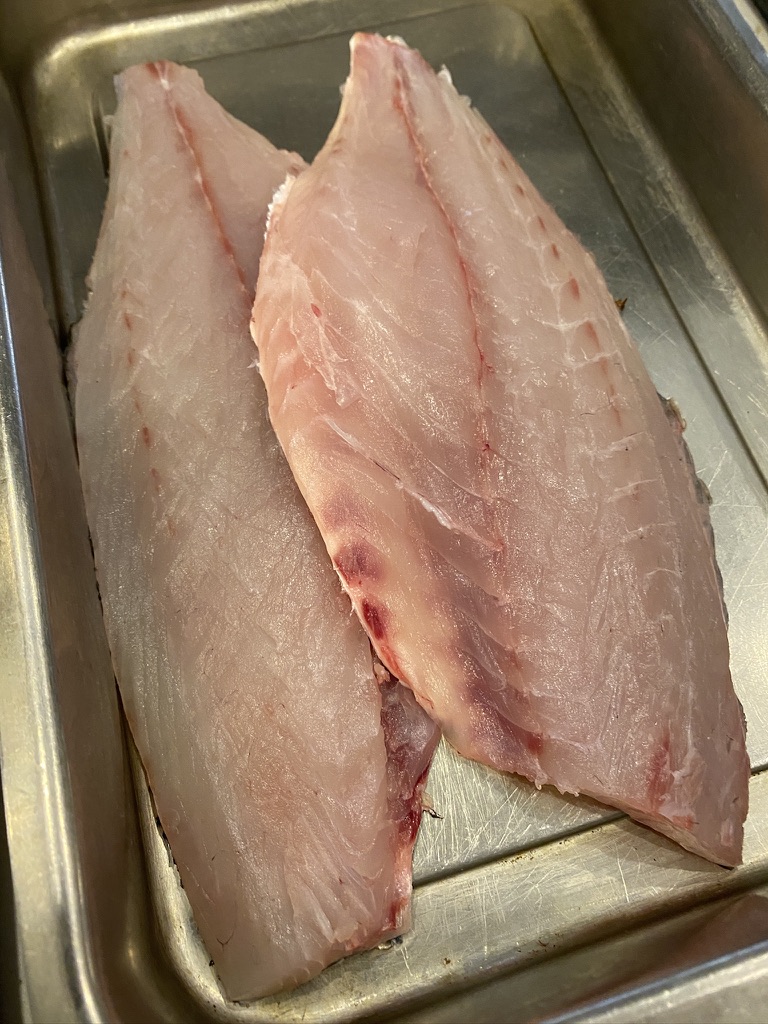
After reviewing the fish on hand at his favourite fish stall, he chose a Daurade Royale Brettone. While the fish monger gutted the daurade, François explained to me that Daurade Royale is distinguished by the yellow stripe on its nose. 

Left photo: François choosing a fish; middle photo: Daurade Royale Brettone; right photo: fish monger gutting our fish

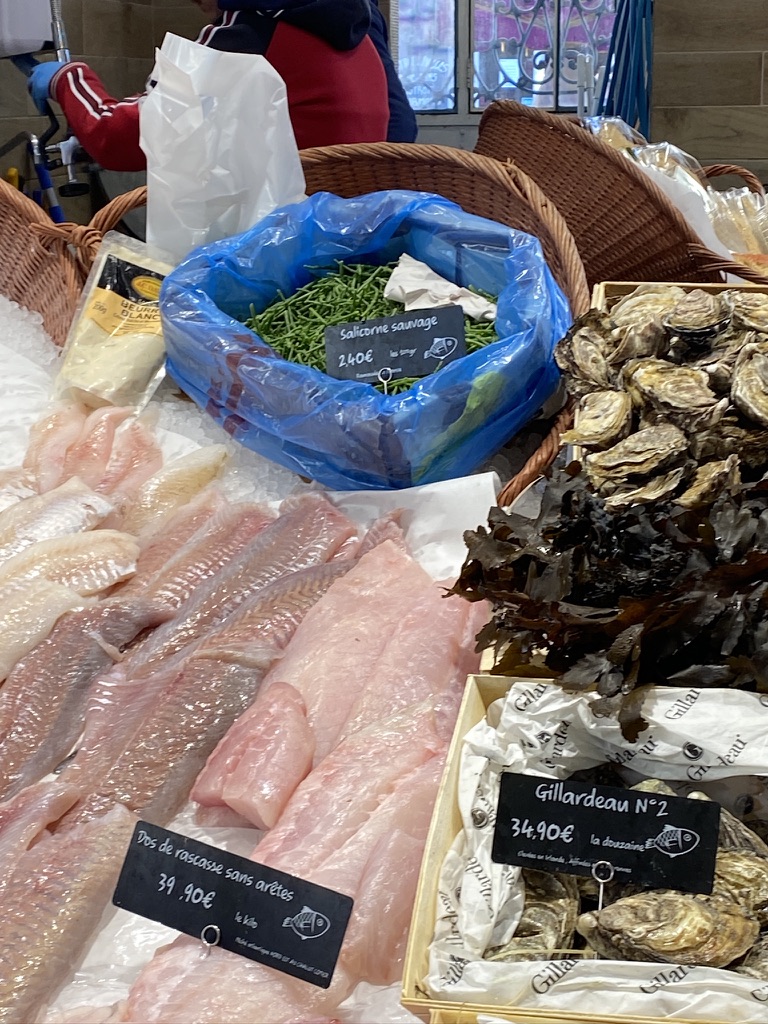
I was surprised to see among the fish a basket marked Salicorne Sauvage. I told François I used to buy that when I lived in Holland, but that I know it as sea asparagus. He asked if I like it and when I said I did he told me to bag some to serve with the daurade.

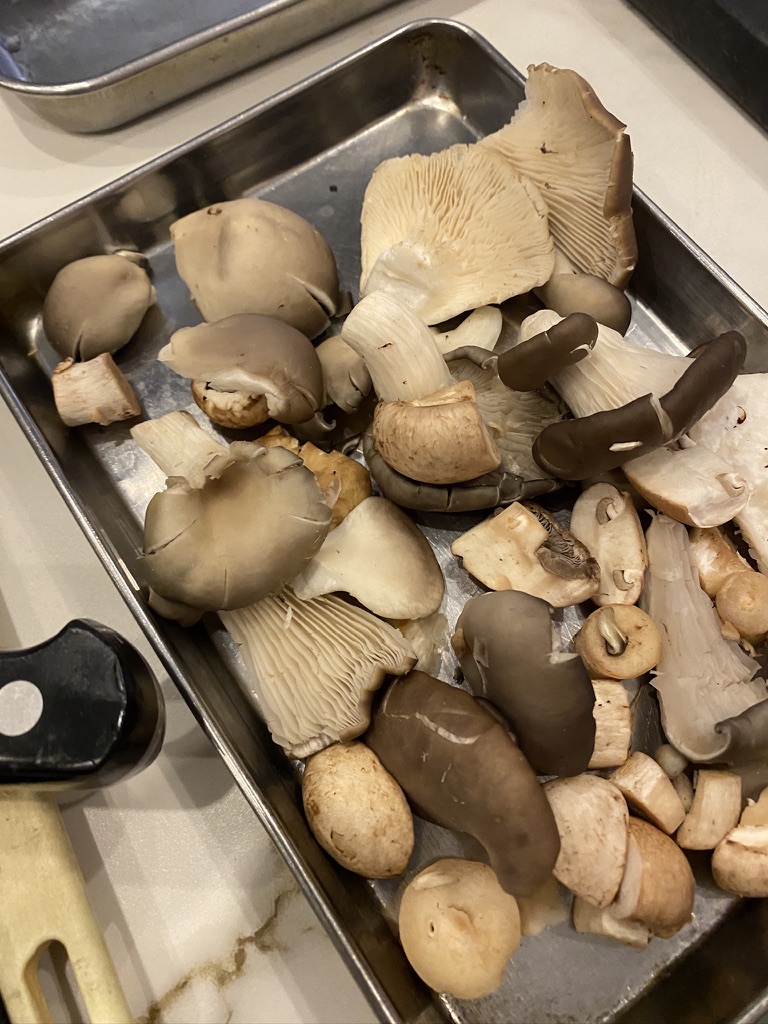
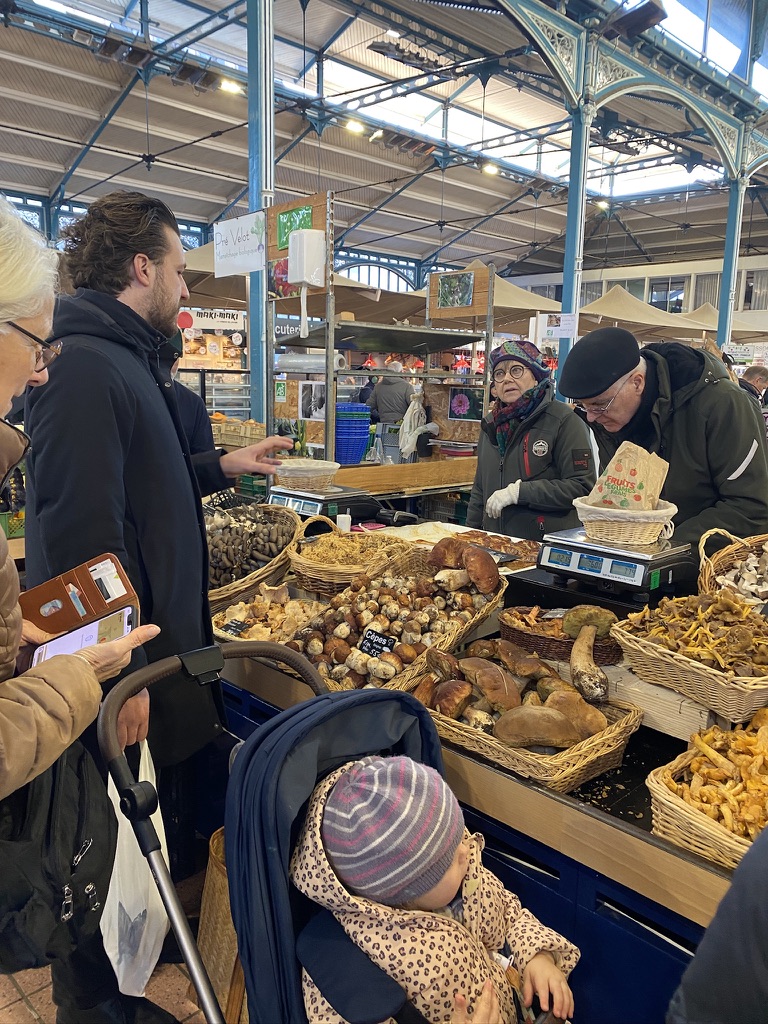
Then he was looking for what to make to accompany the fish. As we walked around, I pointed to a mushroom vendor’s stand and commented about all the different mushrooms — most of which I’d never seen. He asked if I like mushrooms. I do. He chatted briefly with the vendor and next thing I know we had a small bag of mixed mushrooms and the ingredients for our dish was coming together.
As we walked through the market, Sebastian pointed out a few local specialties. He asked if I like pork and I said I do. The next thing I know he’s buying a slice of a Dijon specialty: Jambon Persille — a pork and parsley terrine. I didn’t have the heart to tell him I’m not that keen on terrines. When we got back to the restaurant Sebastian unwrapped the terrine and poured me a lovely glass of red — a 2023 Givry 1er Cru, Les Servoisines — to  go with it. The terrine was absolutely delicious. (The next day I bought a piece to share with my sisters when we met.)

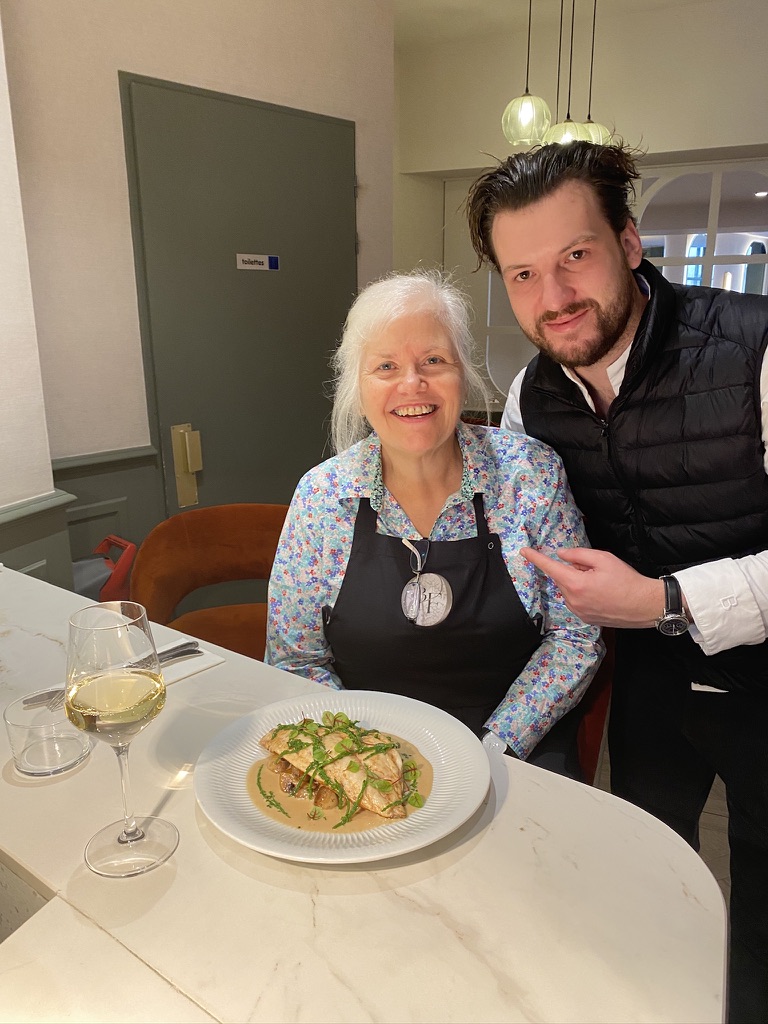
Brasserie François has a semi-open kitchen and as Sebastian and I were enjoying the terrine, I noticed François putting out two cutting boards and various knives and tools. He put the Daurade Royale on one of the cutting boards. He then motioned for me to come into the kitchen. He handed me an apron and showed me my cooking station. Until this point, I thought I’d be watching him cook. 

A private, hands-on masterclass

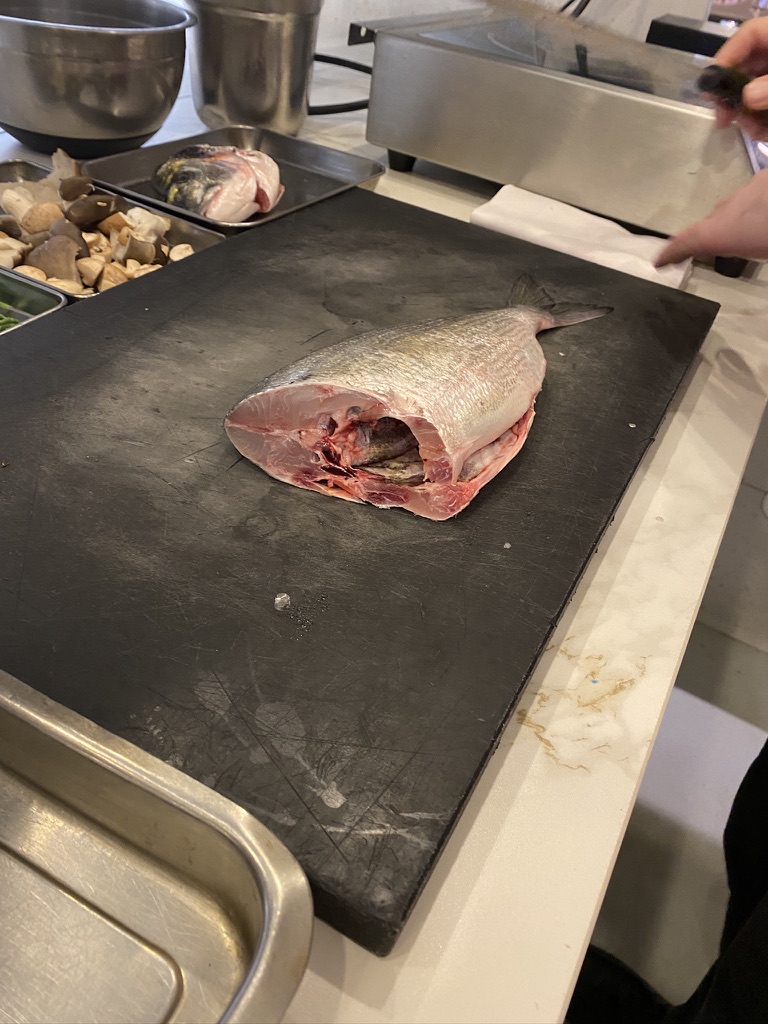
François cut the head of the daurade off and that’s when I realized the fish monger hadn’t de-boned it — he had only taken out the guts. We were going to de-bone it. François showed me as he took off the first fillet, then he turned the fish over and put it on my cutting board. He  explained how I was to move the knife to get the second fillet off. I didn’t do it as quickly as he did, but my work met with his approval.
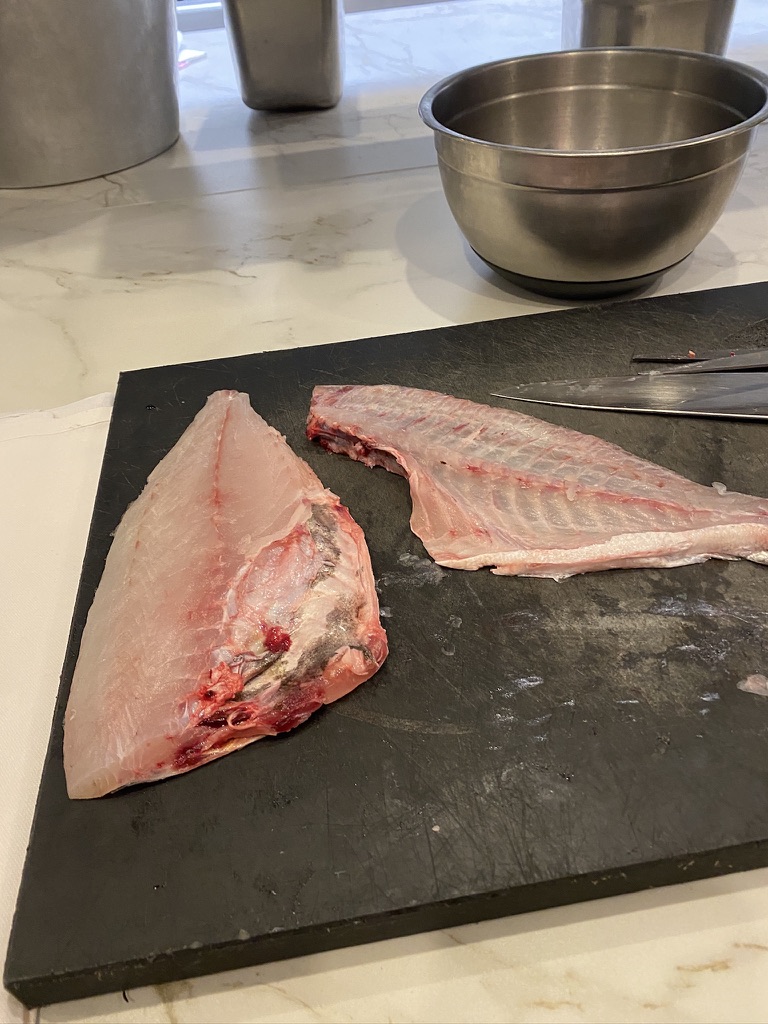
Putting the fillets aside, we then started on the sauce for the fish. It was pretty straightforward: carrots and onion sautéed in a neutral oil and then added to the washed fish bones and set to boil in water. When the water reduced we strained the stock and added heavy cream. We brought it to a boil and then reduced it to a simmer on his professional induction cooktop that automatically cycled between a high and low temperature. (So much better than my induction cooktop!) After straining the sauce we added two secret ingredients: a dash of black garlic paste and smoked fish base. Then, one final chef’s touch: he aerated the sauce with an immersion blender. Texture? I asked. He smiled and nodded.

On to the mushrooms. A simple sauté in neutral oil with a dash of salt to finish. 
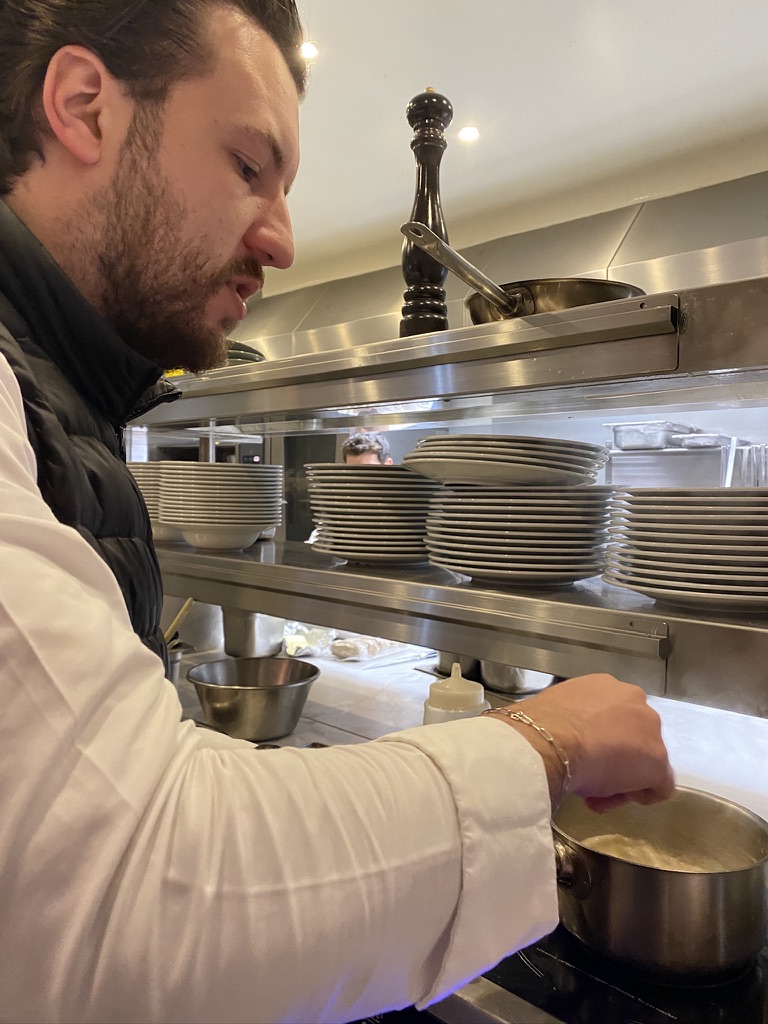
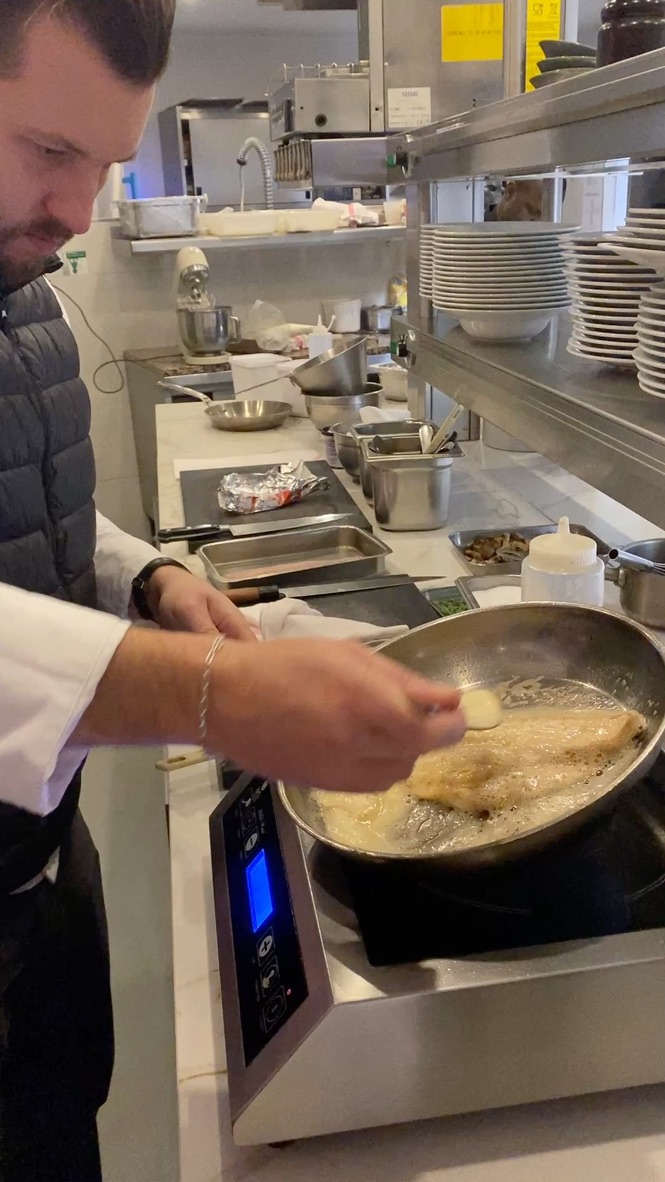
Then it was time to pan fry the fillets. The secret is to put the fillet skin side down in the frying pan (in neutral oil) and then add butter. When the butter melts you tip the frying pan a bit and rapidly baste the top. You don’t flip the fillet — the heat from the butter/oil cooks the delicate fish through.

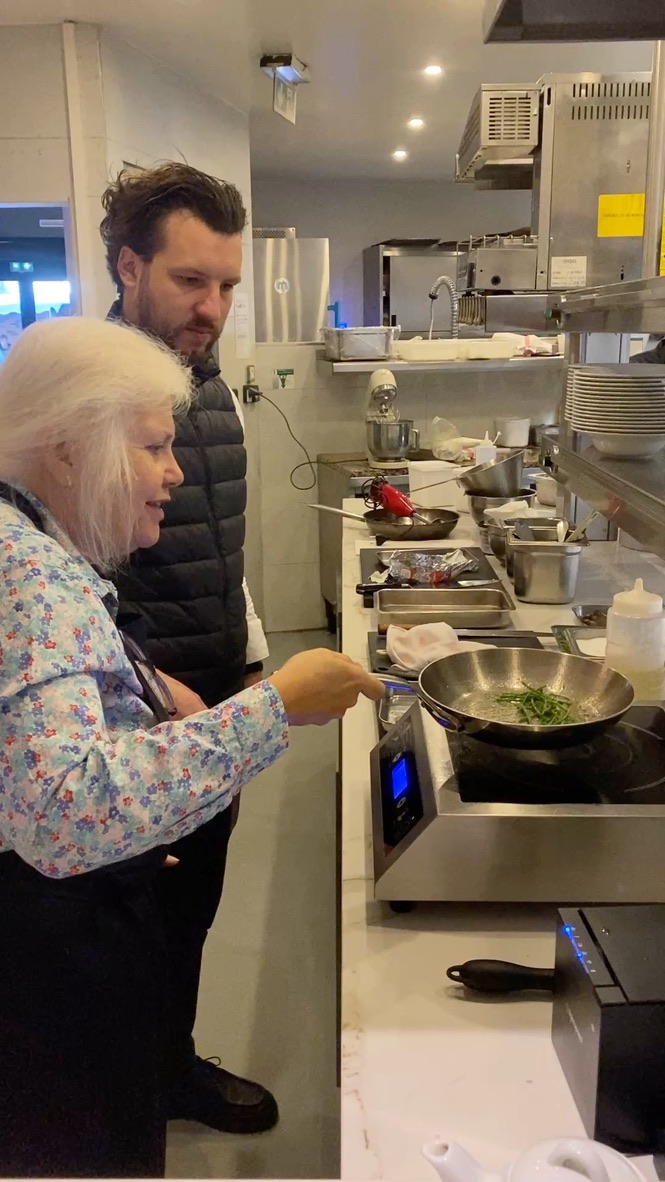
Then it was time to plate the fish. Oh, first he had me sauté the sea asparagus to warm it up a bit. This was my second “opportunity” to practice the chef sauté flip. (I need to work on that a bit more!) 

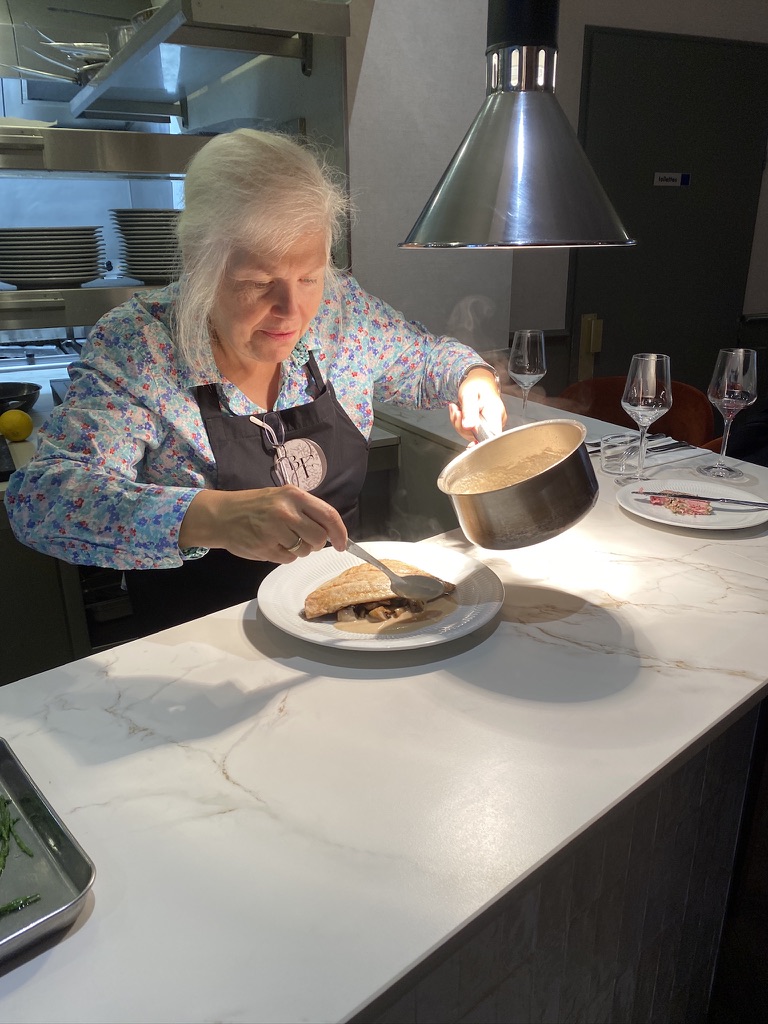
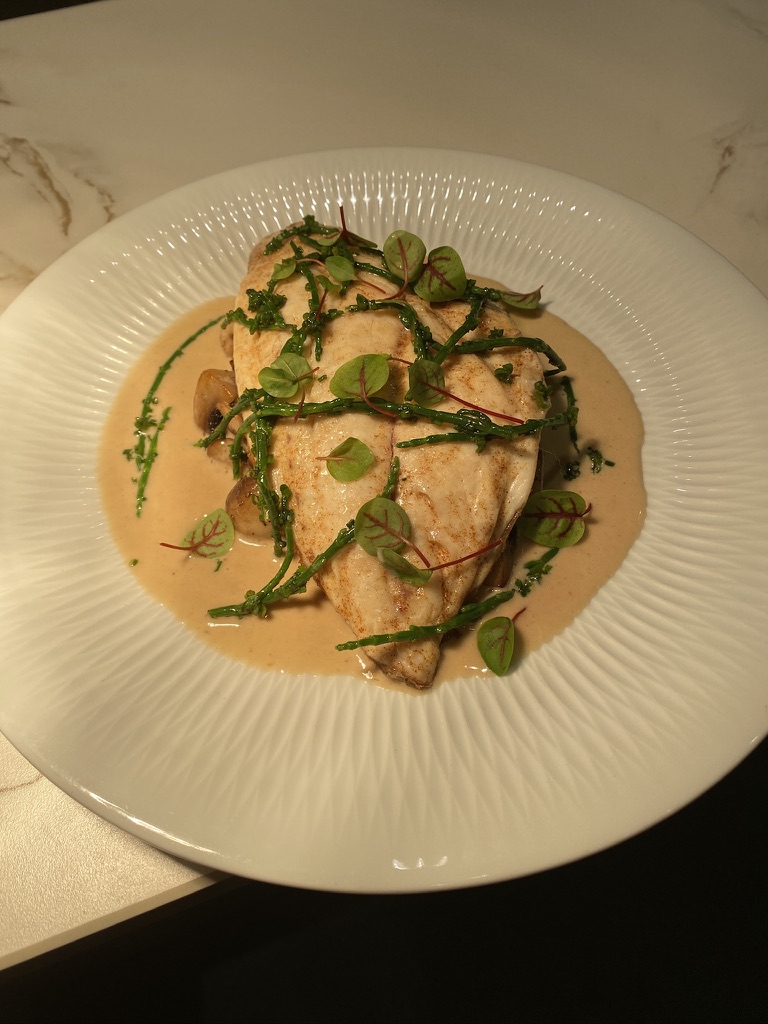
First on the plate was a mound of mushrooms. Then the fillet was centred on top. Then the sauce, which is carefully, but generously, spooned along the sides of the fillet (not on top!). The final touch was a sprinkling of gorgeous microgreens and the sea asparagus. One last thing before digging in — a glass of Saint-Romain Clos Sous Le Chateau Monopole 2022.
An Unforgettable Experience

The Daurade Royale was divine and it went beautifully with the Saint-Romain.

The morning was not quite over for me though — they let me stay on through the lunch service. Chef Evan was happy to tell me about the day’s menu (and the six different sauces he was using for the different dishes that day). Between orders he also made me a few side dishes to try, including that day’s fish (good, but not as exquisite as the Daurade Royale), the dessert of the day (poached pear filled with ice cream and covered in caramel cream sauce), and a Burgundy specialty: oeufs en meurette (poached eggs in a mushroom/red wine sauce).

François Louvel is an amazing chef and a great teacher. He seemed pleased at my interest and enthusiasm and was surprised when I told him that I couldn’t wait to write about my masterclass for the blog. (I hadn’t told anyone about my blog until afterward.)

I have Brice from Maison Philippe Le Bon and François’s wife Anne-laure (who works at the restaurant) to thank for designing this once-in-a-lifetime experience and I’m also grateful to Chef Evan and Sebastian for spoiling me.

Announcing The Founders Series

I’ve started a new feature on the website – a video series focusing on the founders of the Ontario wine industry. The passing of Karl Kaiser in December 2017 got me thinking about the fact that it’s not just the industry that’s maturing…

So, I thought it would be interesting to interview some of the folks instrumental in bringing old world wines to Canada. That’s the idea behind The Founders Series of interviews.

The folks featured in these videos had a vision of what Ontario’s climate and land could produce. They were risk takers, hard workers, and “all in”. They were competitors, yet collegial, knowing that while they were making their own wine and creating their own brands, they were also building an industry.

I’ve set up a dedicated page for linking to the video interviews – it’s called The Founders Series.

Herbert Konzelmann

The first video in The Founders Series is of Herbert Konzelmann, owner and founder of Konzelmann Estate Winery in Niagara-on-the-Lake. At 81, Mr. Konzelmann is still the driving force behind the winery that’s celebrating its 30th anniversary this year.

I offer a heartfelt thank you to Mr. Konzelmann for agreeing to speak with me and to Jessica Chorosinski from the winery for helping set this up. Click here to view the video of Mr. Konzelmann.


Digging Stratus Vineyards’ Roots

This weekend the Wineries of Niagara-on-the-Lake are hosting a new event called Dig our Roots. Unlike the popular passport programs, the idea behind this event is to learn more about the unique properties of the appellation from the roots up. For the event, each winery designed its own unique “experience” around the general theme. Stratus Vineyards put together a tutored tasting with the intriguing title: Tried and True, Quirky and New.

Stratus, which opened in 2005, is best known for its luscious blends – the signature Stratus Red and Stratus White, as well as its more moderately priced Wildass Red and Wildass White. To create the blends, winemaker J-L Groux started playing around with growing some grapes you don’t find too often in the region (for example, Tempranillo and Tannat).

These experiments proved rewarding in many ways. Besides providing varieties that add colour and depth to their magnificent assemblages, Stratus has also released some as single variety wines. The tasting was designed to showcase some of these varieties.

Ben Nicks at Stratus Vineyards

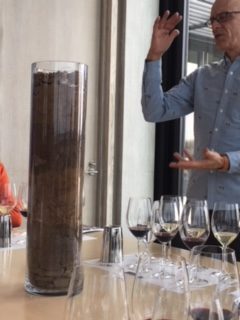
Ben Nicks, senior wine consultant, led the fascinating seminar. From the comfort of the large private tasting room that overlooks the vineyard, Nicks explained the unique geography of the 55-acres. The show-and-tell wasn’t limited to the wines – to show the different strata that lies below the surface, he showed us an oversize glass vase containing a cut-away sample of the vineyard’s soil.

Soil Sample from Stratus Vineyards

He also described some unusual aspects of the winemaking processing. For example, he explained the difference between domestic yeast, wild yeast, and the process they often use (for example, with their Chardonnay), which is to simply rely on the yeast that naturally adheres to the grapes.

It was also fascinating to learn about why and how they aerate wines during the fermentation process. I had heard Nicks describe micro-oxygenation before and how they use a hydrosieve and I was interested in hearing more about it. After the seminar he was kind enough to take my friend and me into the production area for a look at the sieve. He even let me shoot a short video of him describing how it works. You can find the video here.

And of course, during the seminar we tasted some wine – six different varieties: Sauvignon Blanc, Sémillon, Chardonnay, Cab Franc (Stratus’ most widely planted variety), Tempranillo, and Tannat. And, to reinforce the fact that winemaking is an interesting combination of art and science, they provided facts and figures about each wine, including the year the vines were planted, the number of blocks planted of each type, the specific harvest dates for each, and the exact number of days each spent in oak.

An aptly-named event

Hats off to Stratus Vineyards and to the Wineries of Niagara-on-the-Lake for the innovative Dig our Roots event. It’s clear that the experiences created under this aptly-named title are meant to provide wine enthusiasts with a unique way of learning about the appellation – from roots to bottle.

For a taste of the seminar, click here for a short video of Nicks introducing the event and Stratus Vineyards.

Hunter Bottling – a mobile innovation that would make Rube Goldberg proud

I often wonder how wineries can afford all the different types of equipment needed for that precious nectar to go from grape to the bottle I enjoy with dinner. If you’ve ever been to a winery, you’ve probably seen a press, tanks and barrels. But there’s also a raft of special-purpose equipment involved in bottling and labelling.

If a winery can’t afford their own bottling equipment – or if they don’t want to tie up precious space for equipment they may only use a few weeks a year – they have to make alternative arrangements. Sometimes that means shipping their wine via tanker to another winery for bottling. Turns out, another alternative for wineries is Hunter Bottling, a company that’s been offering mobile bottling services for about 15 years. A number of Ontario wineries use them (particularly in the Niagara region, which is where Hunter started).

Intrigued by the idea, I began asking around to find out more about Hunter Bottling and their services. I soon found out that Malivoire Wine Company uses them. So, since Malivoire’s winemaker Shiraz Mottiar is very approachable, I dropped him a line and he put me in touch with Glenn Hunt, founder of Hunter Bottling.

Video

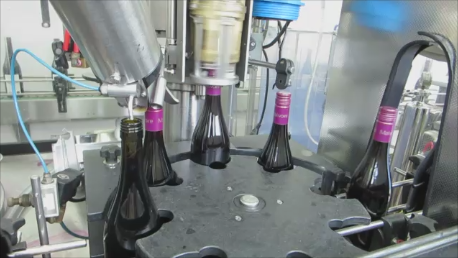
Mottiar was also kind enough to let me stop in (in mid-May) and see the bottling line in action. Click Here to watch a short video of Hunter Bottling at work bottling Malivoire’s 2016 Gamay. Special thanks go to Mottiar for explaining the process and to the crew of Hunter Bottling who let me into the truck as they worked.

Hunter Bottling’s Back Story

Shiraz Mottiar, winemaker at Malivoire Wine Company

Glenn Hunt, who grew up in St. Catharines, was in the winery business long before he started Hunter Bottling. Early in his career he focused mainly on the sales and marketing side (though he also had a successful virtual winery for a while). He was working at Hillebrand at the time Peller (the owner of Hillebrand) was building Peller Estates’ winery on East-West Line in Niagara-on-the-Lake. To satisfy regulations that required Peller to conduct a certain amount of processing on-site at their wineries, Peller had the idea of transporting its bottling line between its two properties: Hillebrand and Peller Estates. So, it outfitted a 53-foot semi with a bottling line.

Because Peller’s mobile bottling trailer sat idle for a fair bit of time, Hunt approached Peller with the idea of him renting the truck from Peller and offer bottling services to other wineries. Peller was agreeable and so in 2002 Hunter Bottling debuted, using Peller’s truck. At about that time, Martin Malivoire was thinking about putting a mobile bottling facility together. Malivoire’s idea was to put the bottling line in a smaller truck, as not all wineries have the space to host a full-size semi.

Malivoire designed a line that would work in a truck’s 22-foot box and Hunt bought the plans from him. Hunt affectionately described the original 22-foot box as a cute little truck and Hunter Bottling used it for quite some time. In 2012 they expanded it a bit and its current fleet is three trucks, each with a 28 foot box (40 feet overall).

In Ontario, Hunter Bottling focuses mainly on the Niagara region, though they also service wineries in various “emerging regions” of Ontario. As well, they service a number of wineries in Virginia. They’re also the Ontario sales rep for the French bottling equipment maker they use for their bottling lines.

And, in case you’re wondering – as I was – Hunt says each fully outfitted truck costs about $750,000. Obviously, it’s quite an investment. So, it’s no surprise that for many wineries it’s more cost effective to hire Hunter Bottling, rather than invest in equipment for a bottling line that sits idle much of the year.

A Typical Bottling Day

Mottiar says that on bottling day, Hunter Bottling’s truck typically arrives at the winery at about 6 a.m. It takes Hunter about 90 minutes to set up and by 7:30 or so, they’re ready to start. The bottling activity involves a combination of winery staff and Hunter staff. Malivoire’s retail staff does the repetitive manual work on the line – things like loading the empty bottles onto the line, taking the full cases of wine off the line and onto the pallets for storing/shipping. Hunter’s staff runs the equipment, cleans it out between runs, and so on.

Speed and other Variables

In terms of the speed of the process, Mottiar says it averages about 3,000 bottles per hour. A variety of factors impact the speed, including some variables I wouldn’t have considered. “It can depend on the wine – some flows quite easily. Reds with some age, for example, usually flow very well. The bottle shape also impacts how fast the bottle is filled, as does whether we’re using a screw top or cork,” said Mottiar.

Another interesting variable they’ve had to contend with is labels that don’t want to adhere. If the wine is too cold, for example, the bottles sweat and then the labels don’t always want to stay on. The day I was there was unusually hot and the stainless steel tank holding the rosé they planned on bottling later that afternoon was starting to sweat. To compensate, Mottiar thought that they’d probably end up having to turn on the air conditioning in the bottling truck to lessen the chance of the bottles sweating.